


Last Updated: November 1, 2026
Quick Summary
You can buy fair trade wellness at specialty fair-trade boutiques, certified-brand direct sites, marketplaces, and museum shops or craft fairs. Choose a retailer that names its makers and materials, then run a five-minute verification pass on the certification before you check out.
- Fair trade certification verifies labor and sourcing standards, not that a product is organic, non-toxic, or healthier.
- Verify a claim by finding the certifying body, checking what is certified, and asking who audits it.
- Our pieces range from $26.00 for a small bowl to $150.00 for a handwoven kimono.
- Start with one piece you will use every day, then build outward from there.
- Handmade sizes vary, so measure your shelf before ordering a large plate.
Table of Contents
- Why Fair Trade Wellness Belongs in Your Home
- The Benefits of Fair Trade Beauty Products and Self-Care
- Fair Trade Certification Standards: What the Labels Actually Mean
- How to Identify Ethical Wellness Companies Before You Buy
- Where to Buy Fair Trade Wellness: Our Curated Collection
- Fair Trade Wellness Beyond Beauty: Categories Worth Exploring
- What Fair Trade Wellness Really Costs, and Why It's Worth It
- Build Your Own Fair Trade Wellness Ritual
- Frequently Asked Questions
Why Fair Trade Wellness Belongs in Your Home
The health and wellness products market is forecast at USD 8.4 billion in 2026, with a projected 8.2% CAGR to USD 18.5 billion by 2036, according to Future Market Insights' market forecast. That growth is pushing more shoppers to ask where to buy fair trade wellness goods they can actually trust. At Pink Pig Westport, we curate artisan pieces that answer that question with names, makers, and materials attached. This guide walks you through the categories, the certifications, and the specific pieces worth bringing home.
Fair trade wellness is the practice of buying health, beauty, and lifestyle products made under verified fair-trade standards, where artisans and producers earn fair wages and work in safe conditions. It connects your daily self-care to transparent supply chains rather than anonymous factories.
The Benefits of Fair Trade Beauty Products and Self-Care
Buying fair trade beauty products and self-care items supports producer livelihoods.
- Named makers. Our listings name the artisan group or cooperative behind each piece.
- Handcrafted origin. Our pieces are handmade by artisans and cooperatives.
- A story worth gifting. Each piece comes with its maker's story, which makes it a thoughtful gift.
One caution: fair-trade status does not prove a product is healthier. The FTC's Health Products Compliance Guidance makes clear that health and safety claims need real substantiation. Buy fair trade for ethics and quality, and evaluate health claims separately.
Fair Trade Certification Standards: What the Labels Actually Mean
Fair trade certification standards are the verified production standards a product must meet to carry a fair-trade label, covering fair wages, safe working conditions, ethical sourcing, and restrictions on forced and child labor.
The labels are not interchangeable.
- Fair Trade Certified (Fair Trade USA). A third-party audit against a published standard, with a certification mark on pack. For agricultural ingredients, the program also collects a social premium that producer groups vote on how to spend. Its shopping guide lists health and beauty among its product categories. What it does not guarantee: that the finished product is organic, non-toxic, or healthier than a conventional alternative.
- Fairtrade (one word, Fairtrade International). A separate system with its own standards and mark.
- Fair for Life and other third-party social standards. Certification bodies that audit labor and sourcing practices.
How to verify a fair-trade claim in five minutes
A short verification pass can help separate a real commitment from a decorative badge:
- Find the certifying body, not just the logo. A mark should name the standards owner (Fair Trade USA, Fairtrade International, Fair for Life).
- Check what is certified. Is the whole product certified, or only one ingredient? A bar soap may carry a mark for its shea butter while the fragrance and packaging are uncertified.
- Look for a license or certificate number. Many programs publish a searchable database of licensed brands and products.
- Read the sourcing disclosure. A credible listing names the country or region and, often, the cooperative or producer group.
- Ask the retailer one question. "Which certification covers this product, and who audits it?"
What certification does and does not guarantee
Certification is a floor, not a ceiling. It verifies that a defined set of labor and sourcing standards were met at the point of audit. It does not guarantee a product is organic, non-toxic, or better for your skin.
That is why transparent supply chains are the real test. The strongest listings combine a certification mark with a named maker, a named material, and a country of origin.
How to Identify Ethical Wellness Companies Before You Buy
You identify ethical wellness companies by checking four things: certification, ingredient origin, maker disclosure, and consistency across the whole catalog.
- Does the listing name the country or region where the item was made?
- Is there a certification mark, or only the phrase "ethically sourced"?
- Are materials named specifically, like sisal, sweetgrass, raffia, or organic cotton?
What most guides miss is the consistency test. Ethical brands apply the same vetting to every category they stock. When a shop can tell you that a bowl was handwoven by a cooperative of women in Uganda and that a kimono was handwoven using ikat technique, that is conscious production you can verify.
Where to Buy Fair Trade Wellness: Our Curated Collection
Where to buy fair trade wellness comes down to a retailer that names its makers and stands behind its sourcing. The right retailer depends on whether you want a $26.00 entry piece, a $150.00 statement, or a refillable staple. Below is how to think about the options, followed by the pieces in our own collection we would put in our homes first.
The four retailer types, and what each is best for
- Specialty fair-trade boutiques (online and in-store). Small, curated catalogs where the maker's name is usually stated on the listing. Best for gifts and statement pieces.
- Certified-brand direct sites. Brands that carry a fair-trade mark on their own e-commerce store.
- Marketplaces and wholesale listings. Broad selection, but the fair-trade claim often sits with the individual seller rather than the platform.
Buying details to compare before you check out
Price is the easiest thing to compare and the least useful on its own. Three other details help decide whether a purchase is practical:
- Product range. Does the shop carry only beauty, or also home, kitchen, and textiles?
- Handmade sizes. Handmade sizes vary, so measure your space before ordering. Our listings publish dimensions where available.
- Care instructions. Confirm care instructions before checkout.
Price tiers, so you can shop your budget
Fair trade wellness is not only a premium purchase. A practical way to plan:
- Under $50.00, entry and everyday. Small bowls and bread baskets.
- $50.00-$100.00, gifts and accents. Plateau baskets, throws, and serving pieces.
- $100.00 and up, statement pieces. Large handwoven plates and artisan apparel.
Our collection, by category
Our collection is built around artisan handcrafted goods with stated origins and materials.
Handwoven baskets and bowls for everyday wellness
Baskets do more than store things. They bring texture and calm to a room, which is why we treat them as wellness pieces rather than utility.
The Indego Africa Leopard Plateau Basket in Mauve ($60.00) is handwoven sweetgrass and sisal, hand-dyed, and sized at 12" x 3" with a loop for hanging. The Coral Mosaic Wooden Bowl by Kazi Goods ($60.00) pairs sisal with jacaranda wood and is food safe for serving.
If you want a statement piece, the Kazi Goods Geo Black Large Plate ($120.00) measures approximately 21" in diameter and is handwoven by a cooperative of women in Uganda. Browse the full range of handwoven baskets and bowls to see the mauve plateau basket up close.
Best for: anyone building a globally inspired shelf or wall display.
Textiles that turn your bedroom into a retreat
Textiles can change how a room feels quickly.
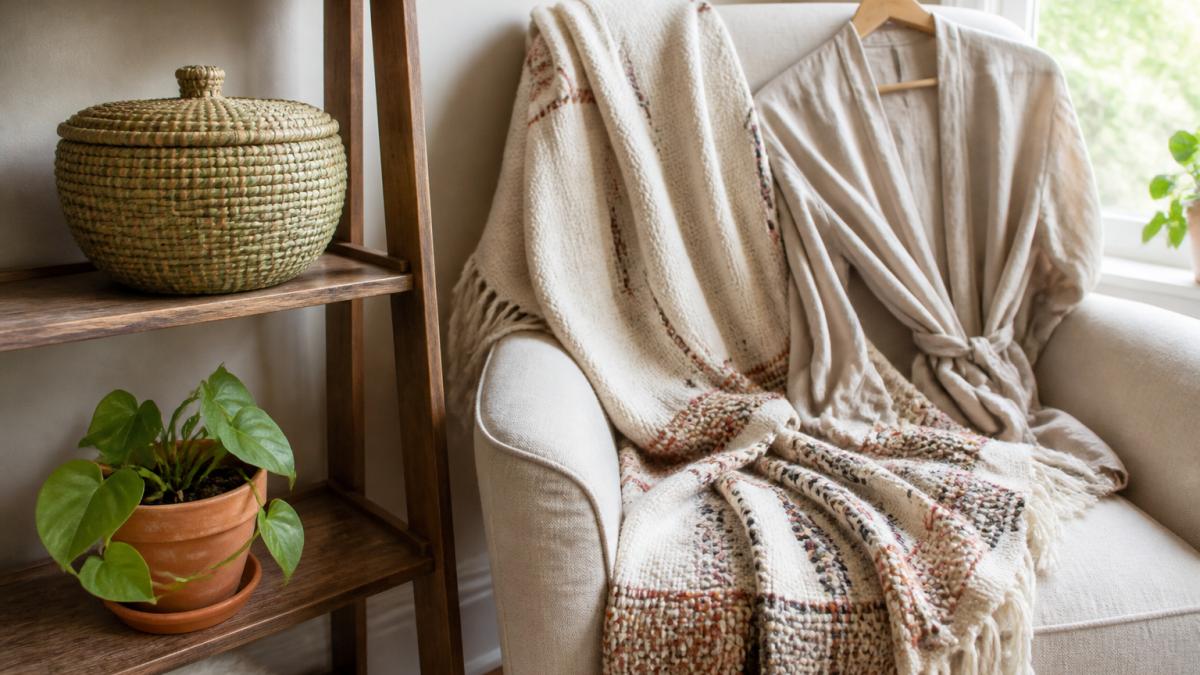
The Moroccan Blankets ($99.00) are handwoven from hand-dyed natural cotton, sized 78" x 58", with oversize pom poms and flecks of metallic silver fiber. They are dry clean only. See the Moroccan blankets in full detail before you commit to a color.

Best for: a guest bedroom or reading chair that needs texture.
Artisan apparel for slow living
Apparel fits naturally into a considered wardrobe. The KLEED Zimbabwe Kimono ($150.00) is 100% cotton with handwoven ikat, a wide belt, and an embroidered butterfly on the back. KLEED is a conscious loungewear brand that partners with Saving the Survivors, a wildlife conservation organization.
Hand wash cold or dry clean. View the KLEED Zimbabwe kimono to check sizing and belt detail.

Best for: a considered gift for someone who values craftsmanship.
Fair Trade Wellness Beyond Beauty: Categories Worth Exploring
Wellness extends beyond skincare, and categories such as home goods, kitchen pieces, and textiles are also part of our collection.
The Moroccan Domed Lid Bread Basket ($48.00) is handwoven from palm leaves and decorated with wool using sustainable dyes.
- Kitchen and table: bread baskets, serving bowls, trays
- Wall and shelf: raffia plates, plateau baskets
- Bedding and throws: handwoven cotton blankets
Each one is made by hand. If you are exploring beyond beauty, the Moroccan domed lid bread basket is a good first step.

What Fair Trade Wellness Really Costs, and Why It's Worth It
Our pieces run from $26.00 for a small bowl to $150.00 for a handwoven kimono.
Here is the honest comparison:
| Piece | Price | Material | Time and care |
|---|---|---|---|
| Kazi Goods Opal Gray Small Bowl | $26.00 | Raffia and sweetgrass | Hand-dyed, spot clean |
| Moroccan Domed Lid Bread Basket | $48.00 | Palm leaves and wool | Handwoven, sizes vary |
| Indego Africa Leopard Plateau Basket | $60.00 | Sweetgrass and sisal | Hand-dyed, 12" x 3" |
| Coral Mosaic Wooden Bowl | $60.00 | Sisal and jacaranda wood | Food safe for serving |
| Star Raffia Plateau Basket | $70.00 | Woven raffia | Hand-dyed, hangs on wall |
| Moroccan Blankets | $99.00 | Hand-dyed natural cotton | Dry clean only |
| Kazi Goods Geo Black Large Plate | $120.00 | Raffia and sweetgrass | Weeks to complete |
| KLEED Zimbabwe Kimono | $150.00 | 100% cotton ikat | Hand wash cold or dry clean |
Note: handmade sizes vary, so measure your shelf before ordering a large plate.
Build Your Own Fair Trade Wellness Ritual
Start with one piece you will actually use every day, then build outward.
The harder question is trust. Plenty of shops say "ethically sourced" and stop there.
Pink Pig Westport is a woman-owned boutique built on carefully curated artisan handcrafted goods, with free shipping on qualifying orders.
Get started with Pink Pig Westport and build a home where every object has a story worth telling.
Frequently Asked Questions
What does fair trade mean for wellness products?
Fair trade for wellness products means the people who grow, weave, or make the item were paid fairly, worked in safe conditions, and had a say in the terms of the sale. For items like handwoven baskets, blankets, or botanicals, it also covers transparent supply chains and ethical sourcing of raw materials. Fair trade certification standards are third-party checks on those promises, but not every artisan brand carries a formal seal, so look for clear sourcing details and producer stories.
How can I verify if a wellness brand is truly fair trade?
Start with the product page. A trustworthy brand names the cooperative, region, or maker behind the item and explains how it was sourced. Look for a Fair Trade Certified seal or a named certifier, plus details on materials and production. If a listing only says ethically made with no specifics, ask the shop directly. Our listings name the maker for many pieces, which gives you something concrete to check.
What are the benefits of buying fair trade wellness items?
You get better-made goods, since handwoven baskets and hand-dyed textiles are built to last, and your money supports fair wages and safer working conditions for producers. Our pieces are made with natural fibers like sisal, raffia, and cotton, and carry a maker's story with texture.
Are fair trade wellness products more expensive?
In our collection, handwoven baskets run from $26 to $120, Moroccan blankets are $99, and the KLEED Zimbabwe Kimono is $150.
Does fair trade certification apply to essential oils and supplements?
It can, but coverage is uneven. If a label claims fair trade, check which certifier is named and whether the claim covers the whole product or just one ingredient.
